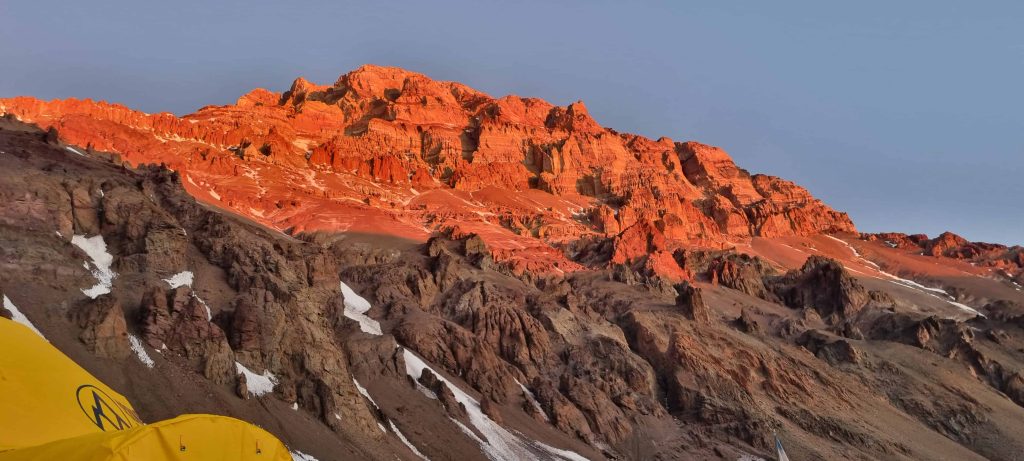
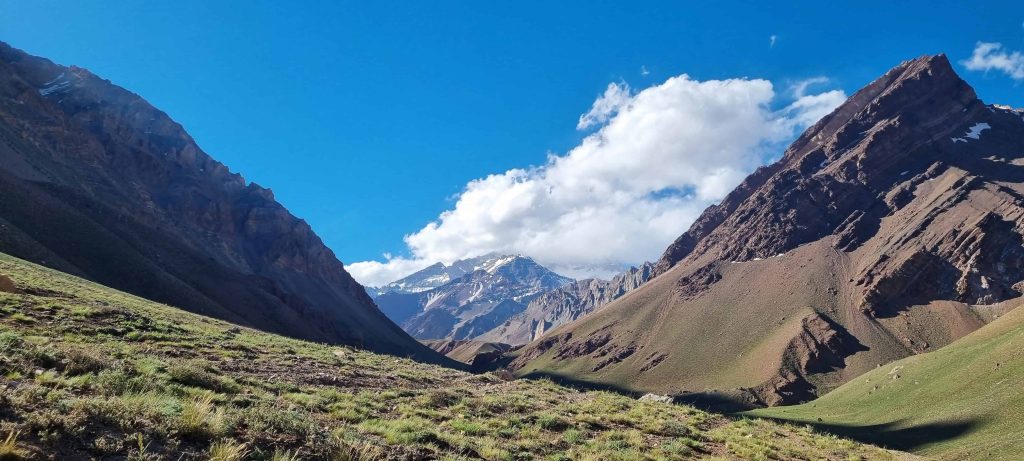
SELF-MANAGED ACONCAGUA EXPEDITION
Live the real challenge of ascending Aconcagua (6,962 meters above sea level) in a self-managed expedition, far from commercial comfort and with the ethics of Andean mountaineering. Small groups, expert guides and an authentic experience for experienced mountaineers.
ASCENT OF ACONCAGUA WITH PURE ANDEAN MOUNTAINEERING ETHICS
Are you looking for a genuine experience on the highest mountain in the Americas?
Our self-managed Aconcagua expedition is designed for mountaineers who wish to reach the summit of the “Sentinela de Piedra” with autonomy, far from standardized services and exclusive rates for foreigners.
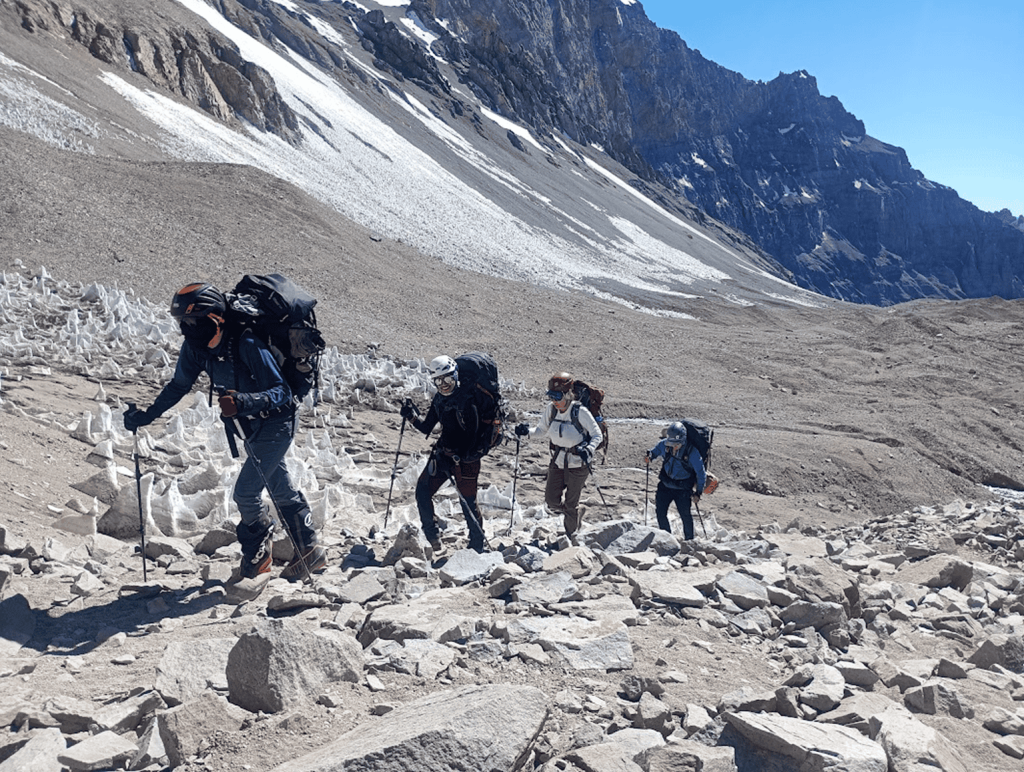
The Aconcagua is much more than a summit: it is a symbol of power and challenge for the native peoples and for those who seek to excel in mountaineering. Our proposal is to return to the roots, prioritizing self-sufficiency, own logistics and teamwork, without depending on commercial infrastructures.Over 16 days (plus 3 contingency days), you will live a real expedition, where every member is an active part of logistics, nutrition and decision-making.
The group is small (maximum 6 people), ensuring personalized attention and efficient dynamics. You will have experienced lead guides and a summit assistant to maximize safety and the chances of success.If you have mountain experience and are looking for a real challenge, this is your opportunity to conquer Aconcagua in an authentic and responsible manner.
( From start to summit )
Route planning
Day 1 — Meeting, planning and final preparation
We meet in the city of Mendoza to begin the expedition. During this day we will hold an informational briefing where the guide will explain the itinerary, safety aspects and group dynamics in detail. A complete check of personal and technical equipment will also be carried out. If needed, there will be time to rent or purchase any missing gear. The rest of the day will be devoted to organizing loads and finalizing details before entering the mountain.
Day 2 — Park entry and trekking to Confluencia
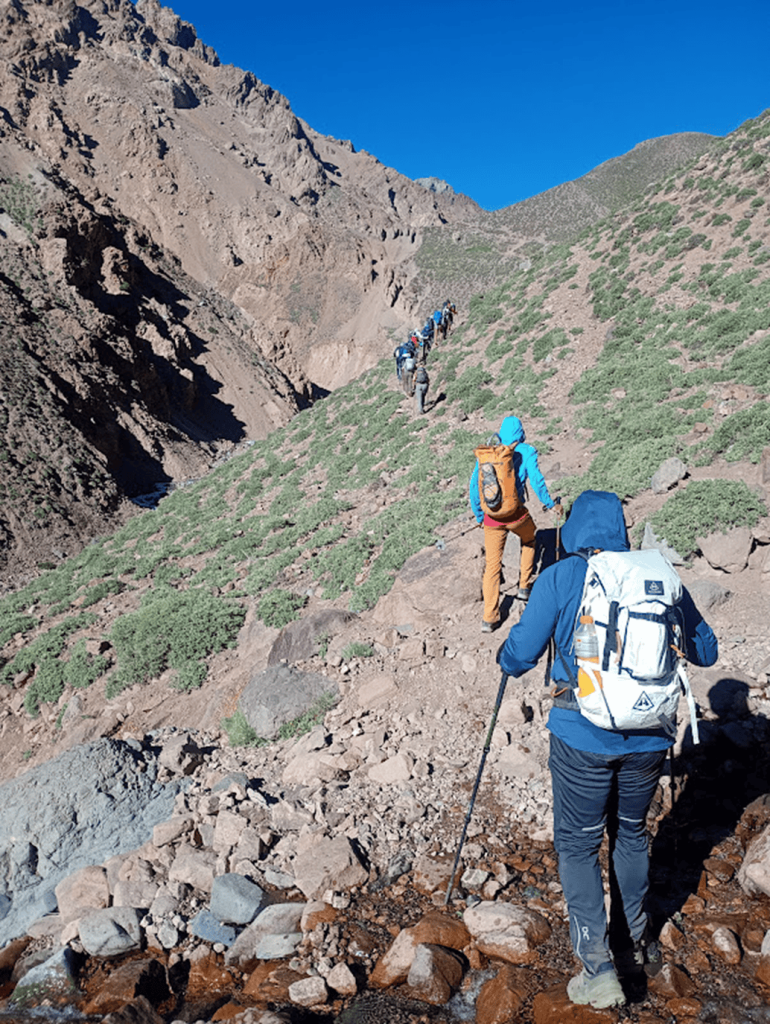
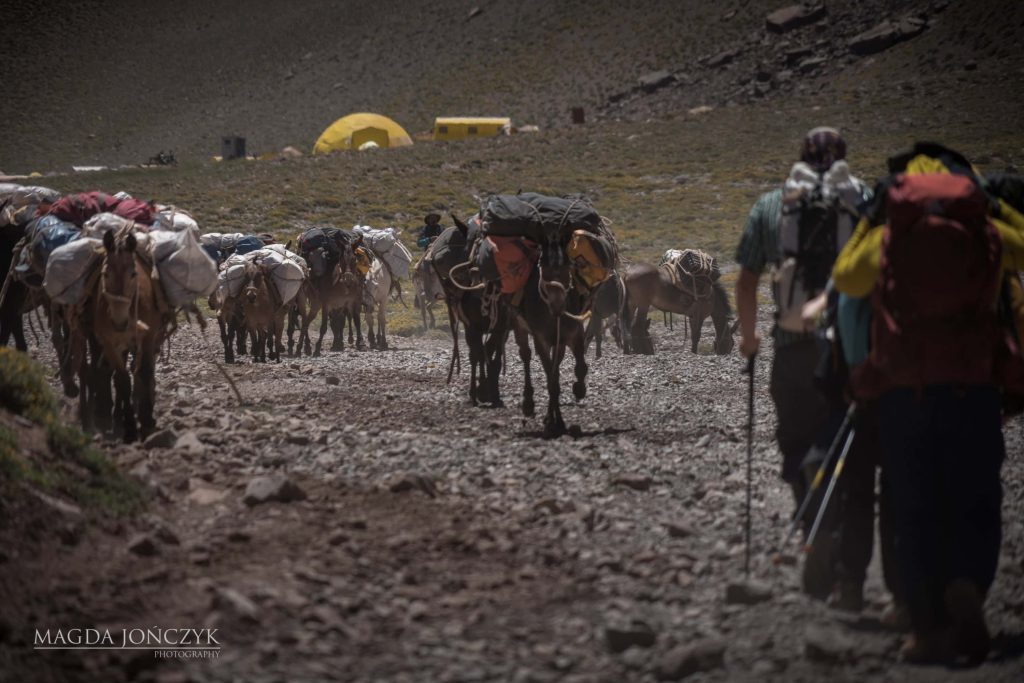
In the morning we travel to Horcones, the entry point to Aconcagua Provincial Park. There we organize the loads that will be transported by mules to Base Camp. We then begin trekking to Confluencia (3,400 masl), the first camp in the Horcones Valley. The walk is gradual and allows acclimatization to begin. Estimated time: 4 hours.
Day 3 — Acclimatization and visit to the south face viewpoint
We take an acclimatization hike to the south face viewpoint of Aconcagua (4,000 masl), one of the most impressive points in the park. The objective is to help the body adapt to altitude under the principle of "climb high, sleep low". We have lunch there, enjoying the views, then return to Confluencia. Total duration: 6 to 7 hours.
Day 4 — Trekking to Plaza de Mulas Base Camp
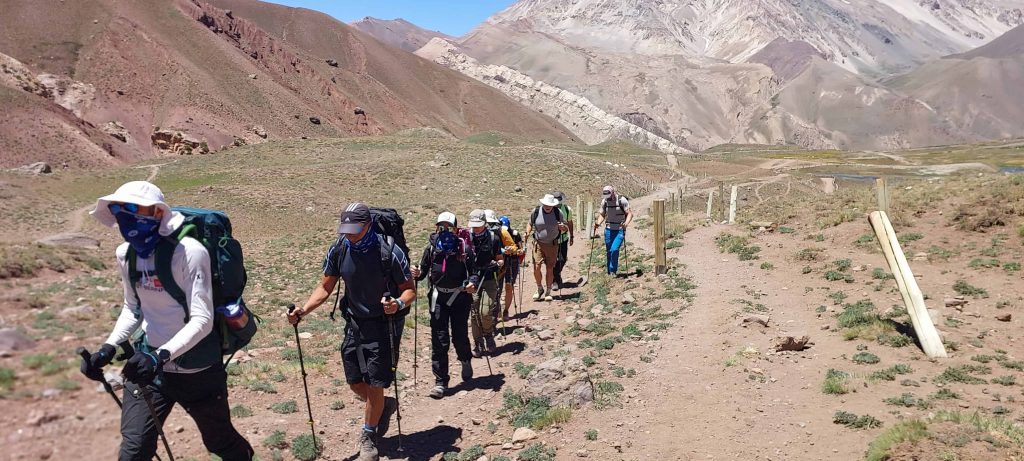
We have an early breakfast and, after organizing the loads, begin trekking to Plaza de Mulas (4,370 masl), the main Base Camp on the normal route. It is a demanding but key day in the expedition. Along the way we cross the upper Horcones Valley with open views and an imposing landscape. Estimated time: 8 hours.
Day 5 — Rest and adaptation at Base Camp
A fundamental day for acclimatization. Active rest, hydration and nutrition will be key to preparing the body for the upcoming stages. Gentle walks around the camp and equipment checks can be made.
Day 6 — First carry and acclimatization to Camp 1 (Canada)
We begin the progressive ascent process with a carry to Camp 1 (Canada, 5,000 masl). We transport part of the equipment needed for the upcoming stages and then return to Plaza de Mulas to rest. This dynamic significantly improves acclimatization. Estimated time: 4 hours of ascent.
Day 7 — Ascent and overnight at Camp 1
We leave Base Camp and move permanently to Camp 1 (Canada). From this point the most demanding high-altitude experience begins. The day is short but important for adapting to sleeping above 5,000 meters.
Day 8 — Carry to Camp 2 (Nido de Cóndores)
We make a new carry to Camp 2 (Nido de Cóndores, 5,400 masl), one of the most iconic camps on the route. We leave equipment and return to Camp 1 to continue acclimatization. Estimated time: 3 to 4 hours of ascent.
Day 9 — Move to Camp 2
We ascend again, this time to establish ourselves at Camp 2. The views become increasingly vast and the feeling of altitude grows more pronounced. Proper hydration and rest will be essential.
Day 10 — Rest and technical practice
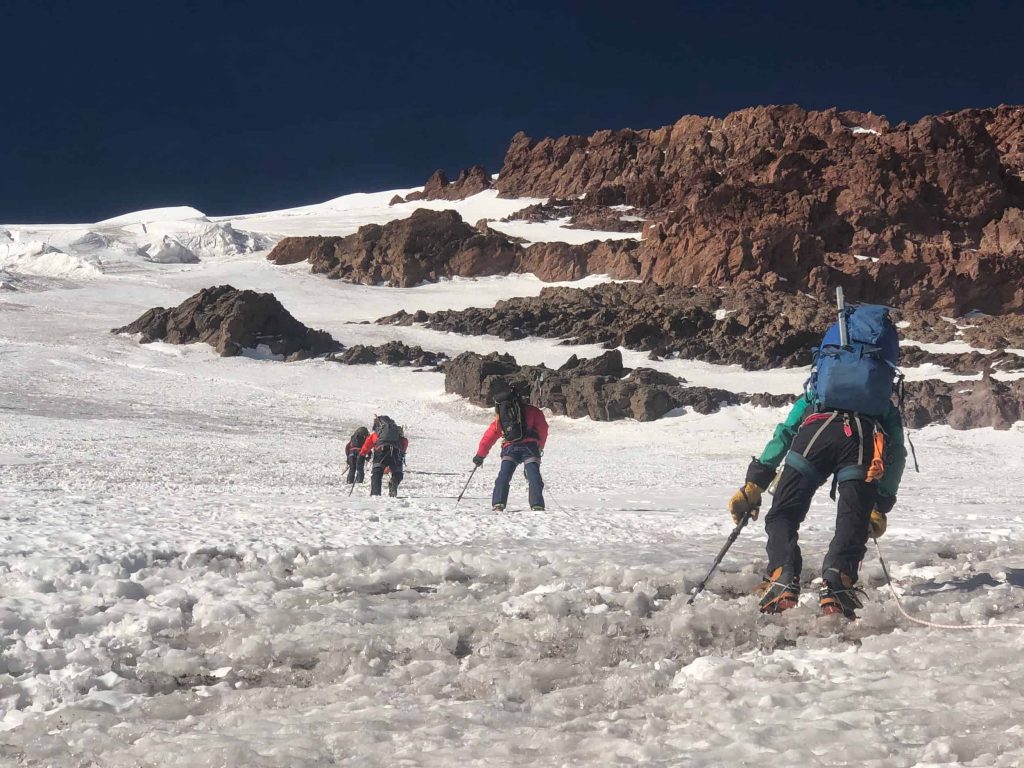
Recovery day at altitude. We take the opportunity to practice crampon use and basic progression techniques on snow or ice, if required by conditions.
Day 11 — Carry to Camp 3 (Berlin)
We make a carry to Camp 3 (Berlin, 5,960 masl), the key point before the summit attempt. We leave strategic equipment and return to Camp 2 to rest and optimize acclimatization.
Day 12 — Recovery at altitude
A full rest day at Camp 2. Physical recovery, nutrition and weather assessment are prioritized to plan the summit attempt.
Day 13 — Ascent to Camp 3 and summit preparation
We ascend to Camp 3 (Berlin), where we spend the night before the summit attempt. A final gear check, intensive hydration and planning of the departure time are carried out. If conditions allow, we prepare to make the summit push the following day.
Day 14 — Aconcagua summit attempt
The key day of the expedition. We set out before dawn (between 4:00 and 5:00 a.m., depending on conditions and the guide's decision). The ascent to the summit (6,962 masl) may take 8 to 10 hours, followed by a descent of 3 to 5 hours. Reaching the summit of Aconcagua is a unique physical and mental challenge. We return to sleep at Berlin.
Day 15 — Descent to Plaza de Mulas
We begin the descent to Plaza de Mulas. It is a long but rewarding day, as we start to leave the extreme altitude behind and recover energy at Base Camp.
Day 16 — Park exit and return to Mendoza
We descend from Plaza de Mulas to Horcones. Private transport awaits to take us back to Mendoza (approx. 8 hours). Arrival at the hotel in the afternoon/evening.
Days 17, 18 and 19 — Extra safety days
Additional days are included to adapt to adverse weather conditions or acclimatization needs. These days significantly increase the probability of summit success.
( added to your experience )
Expedition coverage
Services included
- Advisory support before and during the expedition
- Mules for personal high-altitude gear and group equipment to Plaza de Mulas
- Full board throughout the mountain
- Licensed and experienced guides
- VHF communication on the mountain
- Guide ratio 3:1 (2:1 on summit day)
- Shared expedition equipment (tents, stoves, etc.)
Services not included
Mandatory evacuation insurance, required by Aconcagua Park (except for Argentine citizens).
● Climbing permit issued by the Aconcagua Provincial Park.
● Personal porters.
● Any costs incurred due to evacuation or withdrawal from the program.
● Accommodation, meals and drinks in Mendoza
● Any other service not mentioned in these conditions.
Price
The price of the self-managed Cerro Aconcagua expedition is USD 4,500 cash, with the option to pay in installments.
( Everything you need to know )
Frequently Asked Questions
What does it mean for the expedition to be self-managed?
It means we do not rely on external commercial services (high-altitude hotels, porters, cooks, pre-set tents, etc.). Each member is responsible for their own gear, food, camp setup and daily logistics, under the coordination and supervision of the guides.
What previous experience do I need to participate?
Verifiable mountain experience is required, including use of technical equipment (crampons, ice axe, high-altitude stove), and having completed at least one multi-day high-altitude expedition. This is not a trip for beginners.
How are participants selected?
Before confirming your spot, we conduct a personal interview to assess your experience, physical and mental condition, and compatibility with the group. We seek a homogeneous and committed team.
What level of physical fitness is required?
You must have regular training, cardiovascular endurance and strength. A mountain-specific training plan is recommended at least 3–4 months before the expedition.
What personal equipment do I need to bring?
Each participant must have high-mountain technical gear (double boots, -20°C sleeping bag, down jacket, crampons, ice axe, etc.). A pre-expedition check is conducted and advice is given on renting or purchasing equipment in Mendoza.
What self-managed tasks are shared during the expedition?
Setting up and breaking down camps, cooking, melting snow, filtering water, carrying equipment, camp cleaning, waste management and daily logistics. All under the guidance and supervision of the leaders.
What happens if someone cannot continue or must leave the expedition?
Self-management means each person must be prepared to handle unexpected situations. If someone must withdraw, evacuation is coordinated according to Park protocols, but costs and logistics are the participant's responsibility
.How is safety managed in a self-managed expedition?
The guides have VHF communication, a high-altitude first-aid kit and experience in emergency management. However, each participant must take responsibility for their own wellbeing and actively collaborate in risk prevention.
What happens if weather prevents the ascent?
The itinerary includes 3 extra contingency days. If weather does not allow a summit attempt, safety is prioritized and decisions are made jointly with the guides.
What is the food situation during the expedition?
Full board on the mountain is included, but each member participates in meal preparation, melting snow and cleanup. The menu is adapted to high-altitude nutritional needs.
Can I hire personal porters?
No, personal porters are not permitted on this expedition. Each participant must carry their own personal gear and contribute to the shared team equipment.
What permits and insurance do I need?
It is mandatory to obtain the climbing permit from the Aconcagua Provincial Park and to have evacuation insurance (except Argentines). We advise you through the process.
What happens if I suffer an injury or altitude sickness?
The guides are trained to respond to emergencies, but self-management means each person must monitor their own condition and report any symptoms promptly. Evacuation follows Park protocols.
How is water and hydration managed?
The group is responsible for melting snow and filtering water at high-altitude camps. Everyone's collaboration is essential to ensure daily hydration.
What happens if there are disagreements or conflicts within the group?
Coexistence and teamwork are key. Open communication and consensual decision-making are encouraged, always under the coordination of the guides.
Can I join individually or do I need to come with a group?
You can join individually. The group is made up of mountaineers with similar profiles, selected in advance.
What happens if I don't have all the necessary equipment?
In Mendoza there are options to rent or purchase technical equipment. A pre-expedition check is conducted and we advise you to ensure nothing essential is missing.
What is the acclimatization process like?
The itinerary is designed for progressive acclimatization, with rest days and intermediate carries to maximize the chances of success and safety.
What documents do I need to bring?
National ID or passport, climbing permit, evacuation insurance and updated medical form.
What happens if I don't reach the summit?
The main objective is the mountain experience and safety. The summit is a goal, but it is not guaranteed. The health and wellbeing of the group is always the priority.
Photo gallery